The Sanctuary Windows of Peace Lutheran Church, St. Louis MO
Emil Frei & Associates, Will Frank, designer
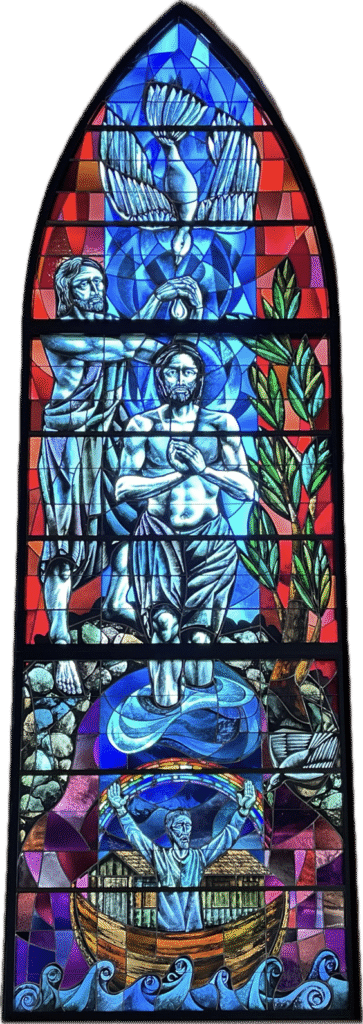
THE BAPTISM WINDOW
To the left of the altar is the Baptism Window. Christ is shown standing in the waters of the Jordan as John the Baptist pours the baptismal waters upon Him. The Holy Spirit, in the form of a dove, descends upon Jesus (Matthew 3:16; John 1:32-34). An olive tree grows to the left of Jesus. The olive tree (and the olive branch) is a symbol of peace and, ever green, of life.
The Baptism of Jesus by John was a baptism of the repentance of God’s people. Jesus did not need to repent, but was baptized because it is what God’s faithful people did, and it was a part of His perfect life He lived on our behalf (Matthew 3:14-15). The Christian Baptism, given by Jesus, brings us the Holy Spirit, forgiveness, and new life in Jesus (Matthew 28:16-20; Acts 2:38-39).
Below Jesus is the Old Testament event which foreshadows (or prefigures) Baptism – Noah and the Flood. Noah is depicted in a manner of praise as the dove returns to him with an olive branch in its beak, symbolizing both new life on the earth and God’s peace with man. The rainbow reminds us that God has set aside the bow of His wrath. Peter points out the link between Noah and Baptism: just as God saved Noah as he passed through waters via the ark, God saves us via His name with the waters upon us in our Baptism (1 Peter 3:20-22).
THE CRUCIFIXION WINDOW
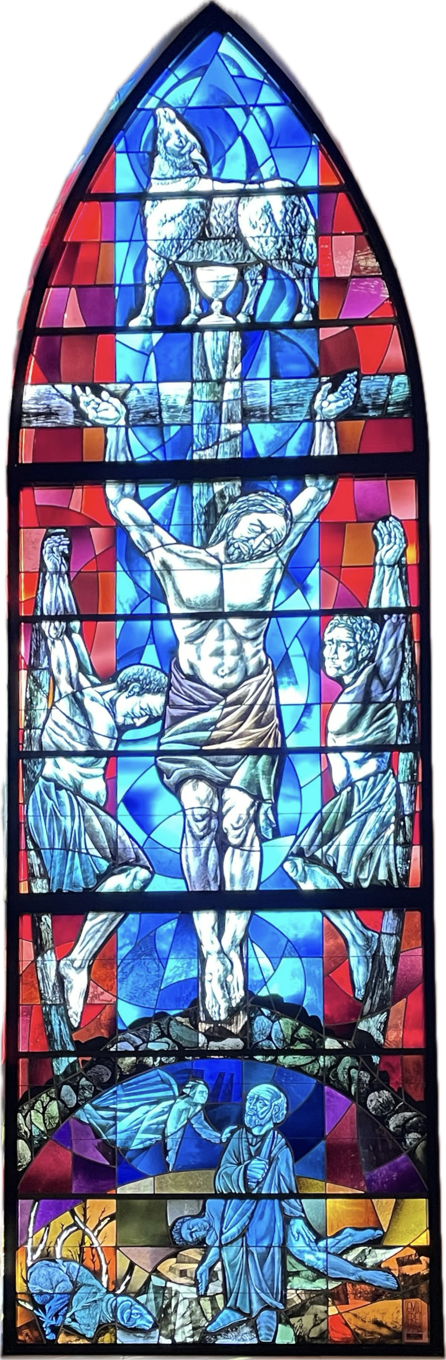
To the right of the altar is the Crucifixion Window. Christ is shown crucified, flanked by the two thieves. One of the thieves has his head down in despair, the other looks to Jesus for hope (Luke 23:39-43), as all have hope who look to Him (John 3:14-17).
Above Jesus are a lamb and a cup. Jesus is the Lamb of God who takes away the sins of the world (John 1:29), and the Cup of the Lord’s Supper below it signifies the Sacrament wherein Jesus continues to bless us through His Body and Blood. The blood poured out from the Lamb Without Blemish is the Blood of Jesus by which our forgiveness has been obtained. The Lamb is facing the altar which holds the Lord’s Supper during the Divine Service.
Below Jesus is the Old Testament event which foreshadows Jesus’ crucifixion. Abraham is set to sacrifice his only son Isaac as God had directed, but God’s angel arrests his arm, pointing to the ram, which serves as the replacement sacrifice (Genesis 22:9-14). Where God stopped the hand of Abraham, God the Father’s own hand did not stop, that Jesus would enable the salvation of us all.
THE DARKENED SUN WINDOW
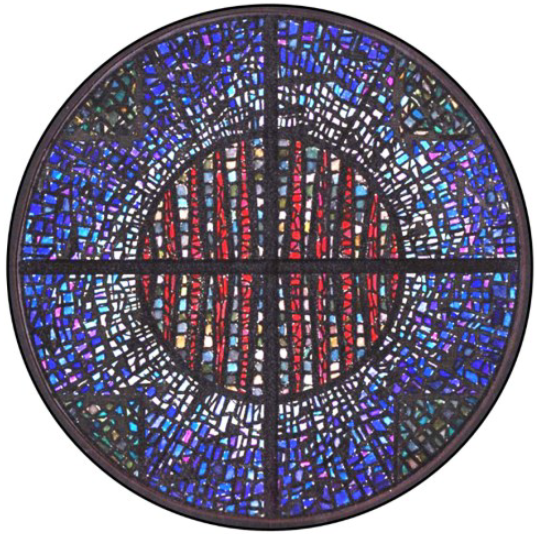
The center of the chancel is highlighted by the Darkened Sun Window behind the cross. This window captures the most sorrowful and painful moment in all of time, when God the Father forsakes His Son for our sakes. In Jesus’ words “My God, My God, why have You forsaken Me?” (Matthew 27:46; Mark 15:34), we hear Christ’s words of substitution, taking the penalty of our sins, separation from God, onto Himself. Matthew speaks of darkness over three hours, and Luke adds that it is because “the sun failed” (Matthew 27:45; Luke 23:44-45).
This description is not an eclipse, which only darkens the earth for a few minutes, but something much greater acknowledging the nature of Jesus’ death for us. The window is muted in color not only because of the physical darkness of the event, but to bring us sober, thoughtful contemplation of what Jesus endured for us.
THE PENTECOST WINDOW
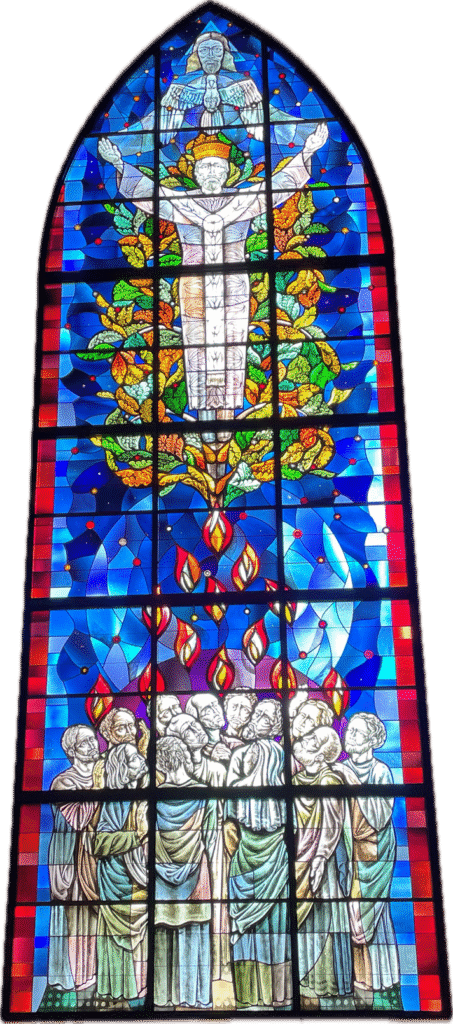
At the top of the Pentecost Window, God the Father sends the Holy Spirit who, in turn, points us to Jesus. Yet, at the same time, the hands of Father and Son are unified with the wings of the Holy Spirit, signifying that our God is Triune.
Jesus is depicted in His resurrection victory, ascending to Heaven. He wears the robe of the High Priest who mediates for His people before the Father (Hebrews 7:23-28) and also wears the crown of His kingly state. Jesus is also the True Vine, green with life, depicting our life connected to Him (John 15:1-11).
Below Jesus is a depiction of Pentecost. The tongues of flame are on the disciples as they look up in faith toward Jesus. They are together in the room on that day, about to be sent out into the world to begin the Church. The astute observer will notice thirteen persons presented. The person in the front center, facing away with head covered, is Mary, Jesus’ mother, who was with the disciples in the room (Acts 1:12-14; 2:1). Her addition is a reminder of the great change in Jesus’ family as they came to faith in the event of His resurrection.
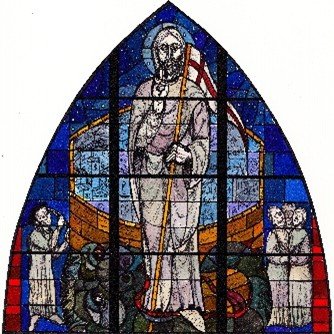
THE CHOIR WINDOW
Above the stairs to the balcony is the Choir Window with a famous Reformation image of Jesus. He stands at the center holding His flag of resurrection triumph. The flag is on a lance which pierces Satan, as dragon, below Jesus. The feet of Christ, one in and one out of Satan’s mouth, depicts the first proclamation of Gospel to the world (Genesis 3:15).
Jesus stands before a city with high walls for protection. In these days, Jesus is the protector of His people. It is also a reminder of the promise of the New Creation of the Last Day. Written on the walls is Martin Luther’s Reformation hymn A Mighty Fortress is Our God in the original German. Luther is seen on the left as he pens the hymn, and it is sung by the choir to the right.